The title of this particular post could refer to many things, including that right now I am very full from Thanksgiving dinner: day 3. The subject might also allude to this blog which is--oh woe--full of neglect. I have not been especially faithful to this site, betraying my commitment to it by attending to the Pivot blog. However, for what it's worth, gentle reader, the Pivot Point I made today was book-informed.
Tuesday, October 11, 2011
Full of it
The title of this particular post could refer to many things, including that right now I am very full from Thanksgiving dinner: day 3. The subject might also allude to this blog which is--oh woe--full of neglect. I have not been especially faithful to this site, betraying my commitment to it by attending to the Pivot blog. However, for what it's worth, gentle reader, the Pivot Point I made today was book-informed.
Sunday, September 11, 2011
Uneven Developments: The Ideological Work of Gender in Mid-Victorian England by Mary Poovey
This entry might also be called “Praise Be the Ambleside Book Barn: Part II.” Of course, in line with what Ferg so coherently argued tonight about the conventions surrounding academic article titles, I could also get away with calling it anything, including “Shitting Bricks: The Structure, Function and Epistemic Irregularities of Victorian Discourses in Mary Poovey’s Uneven Developments” (if anyone wants to contradict this, they’re going to have to deal with Jerome Bruner’s arguments about the hermeneutic composability of narratives first. Oh, and Ferg. Wouldn’t mess with that one—she’s a smart un).
Silliness aside, have I mentioned that I wish I had read this book last year? No? Well, I wish I had read this book last year when I was trying to hash out the why and how of reading Victorian parliamentary debates.
Poovey’s ambitions for this book were bigger than mapping out the ideology that gave power to and was driven by the workings of Parliament. Indeed, she sought to draw broad conclusions about Victorian society, and consequently based her reading a variety of texts (Hansard transcripts, pamphlets, medical books, literature, training manuals, Royal Commissions) and sites (the controversy over chlorophorm, rise of anaesthesia, divorce, work). More specifically, she sought to demonstrate that society varies the rights and responsibilities it devolves to people based on how it argues they are different.
Poovey argued that, in the case of gender, there seemed to be an ethical consensus that the prevailing distinction between the roles of men and women was correct. However, the logic from which people drew their ethical argument was inadequate. To offer one example, Poovey showed in the first chapter that doctors were unable to justify their authority over women’s bodies with their putative physiological expertise (try as they might in this time when midwives, clergy, and doctors competed for epistemological sovereignty over women’s bodies... I’m sure there was a less pretentious way to say that). Instead, doctors’ arguments hinged on moral points that sounded clerical (not clinical).
Poovey clearly wrote clearly insofar as my puny brain could keep track of her overarching argument as I read her work. Having said that, while I was making my way through the chapters, sometimes I found it hard to connect/remember and follow the many subpoints she made. While outlined her argument well, my lack of familiarity with her knowledge register (e.g., discussions of political economy) made it hard for me to follow it point-by-point at times. But don’t worry, Mary Poovey, it’s ok; I forgive you for my ignorance. Haha.
Another reason I think it was sometimes hard to follow her argument was because she didn’t set out her chapters like a line-drawing, moving down the line of argument to the other, point-by-point. Instead, she began each chapter with an overview of the issue she sought to illustrate, and then in the subchapters she sketched out the particular parts. To use her chapter “David Copperfield and the Professional Writer” as an example, in the first part Poovey began with a close reading of DC in which she laid out evidence suggesting that men were envisioned as dynamic characters who had the sense to make ethical choices. Women were static, but were integral to structuring the kinds of choices men faced. In part II of this chapter, she abruptly shifts from this microethnographic perspective to one that pans the social landscape in which this story was embedded. It was disorienting immediately moving to an analysis of the debates over the book industry and copy right. Nevertheless, her argument for this part concludes with her demonstration that the rhetoric supporting male authors’ compensation for their intellectual property sounded a lot like her reading of the sexual politics in DC (it hinged on the idea that male authors were moral compasses whose work depended on their ability to support their families, because these authors also depended on the support of their families). The way Poovey arranged her evidence is evocative of Plato’s allegory of the cave; one immediately jumps back and twists around from her position watching the shadow play, and finds herself looking at the necessary background. I really like this style because it highlights for the reader that different parts of an author’s arguments depend on different sources, all of which have different limitations. However, I think this particular juxtaposition might have avoided the same level of mental gymnastics had Poovey bridged these discussions with her consideration of Charles Dickens—the intermediary between these sites (I’m sure Poovey appreciates this constructive criticism. I should send her my masters work because it absolutely never, ever, ever had any questionable transitions).
In any case, I le dug this book. It was fascinating for me to see how she put together her work, and very impressive to see how she interrogated so many different texts and sites. It’s not often that I pick up a book and not only am interested but also feel inspired. However, as I went through Poovey’s work, that’s exactly how I felt.
Saturday, September 3, 2011
Stella: Unrepentant Madame by Linda Eversole
Among the (many) benefits of having an English Lit major as a frequent companion this summer was that I found myself in the Ambleside Book Barn more than I did at any other time last year. Yes, the two times I went during the last several months represented a massive increase from the zero times I went in otherwise. Now, don’t get me wrong—it’s not that during the other eight months that this particular barn emitted hair curling scents, or was guarded by an intimidatingly stoic, pitch-fork wielding farm couple. No, it’s just that when I usually find myself in Ambleside I am in the company of a beagle who is both impatient (“Bored. Bored. Bored. Bored. Bored.”) and liable to convince herself that the resident Maine Coon would also make a most satisfying main meal.
The first time me and Ferg visited the book shop (BS!) I ended up purchasing a translation of the first volume of “The Novel” (that met with the approval of the Proust scholar standing next to me) and Linda Eversole’s Stella: Unrepentant Madame. I have yet to go the way of the Swann, but—perhaps knowing that time is at a premium with a madame—eagerly started reading Stella soon after I had purchased it.
I was initially very enthusiastic about Stella because I was acquainted with someone who knew the author when it was going in for publication and thought it sounded like an interesting topic, and continue to be interested in the Canadian regulation of vice. However, I think what was most intriguing about this book was that the publisher(?) noted that it was an example of the genre “creative non-fiction.”
From what I can tell from Eversole’s work, creative non-fiction involves the careful study of primary and secondary sources (her book has a bibliography that is separated accordingly). Each chapter also includes a number of endnotes that Eversole uses to point the reader to the particular sources from which she culled information. Unlike the books I have been reading lately (that also tackle history, but are not explicitly classified as “creative” works), Eversole’s text is not interrupted by admissions to gaps in information. Rather, the text is carried by an omniscient narrator. Consider, for example, the narrator’s report on Stella Carroll after she had been busted for running a bawdy house:
[…]Stella sat in jail, her thoughts racing as she massaged the stump of her leg. She would beat this as she had every other time. They don’t send ladies to jail—surely it was just the usual harassment, a small setback, and she’d be back in business by the end of the week. She had to face facts, though: this time it seemed different. The sick, nervous feeling in her stomach wasn’t the aftermath of too much rich food, alcohol and rage. It was what they called a “gut feeling,” and hers was saying there was trouble ahead. (Eversole, 2005, p.16)
Note the particular emotions that the narrator imputes to Stella. This passage is also not followed up by a citation for a journal entry or a personal letter. Perhaps the inclusion of this kind of scene by the author—presumably inspired by Eversole’s impression of how Stella would feel (given Eversole’s understanding of/identification with Stella after twenty years of mulling over sources) is what sets creative non-fiction apart. As in, the author admits that through an analysis of the sources s/he has created a relationship with the subject.
Clearly I find this idea of classifying a book as “creative non-fiction” conceptually very interesting, and compelling. I wish that more books would admit that, no, they are not just repositories of troo fax but represent mediated understandings that can only be further mediated.
Having said this, I really hate omniscient narrators; they just totally rub me the wrong way because I feel like I can’t trust them. More than that, and just so we don’t forget my arrogance, reading things like that makes me anxious that people will be seduced into feeling there is certainty when there is not. In any case, I would welcome the chance to read a creative non-fiction book in which the author made the narrator explicitly unreliable and began the book with a note on method.
Thursday, July 21, 2011
The Grouse Grind as told by Liz Cave and Reflections in a Golden Eye by Carson McCullers
So if this were not a literature blog I could write entries about, for instance, my harrowing experience completing the Grouse Grind with the Livy on Tuesday. She suggested that I could rightfully blog about it if I discussed it as a text. Indeed, I could... for instance, the experience was interrupted by two apparently unreliable narrators... one which marked hikers’ progress up the trail in orange spray paint and the other that communicated through official-looking signs. Other themes included peoples’ apparent jealousy of my jeans, and the Liv character’s tremendous foresight for bringing buns apart from her God-given ones. While this experience may not have been strictly literary, my ultimate justification for posting these observations is that this experience was occasionally litterey, and surely the two being almost homonyms makes them pretty well synonymous. See, no difference, only diffĂ©rance.
To salvage this entry to a topic that is more literally literature, I just finished Carson McCullers’ Reflections in a Golden Eye. I think Liv described the McCullers as “sensitive but not sentimental.” This is evinced in the narrator’s preoccupation with the relational dynamics between characters that seem to inform their actions, over certain gruesome “symptoms” of those relationships (like a character cutting off her nipples with garden shears).
I observed many parallels between this work and the film American Beauty. It contains a male military officer who hates/identifies/loves someone who in many ways seems detached from “The System” and who kills him in a murder suicide. A mysterious and socially unattached young man who becomes enamoured by a woman. A character who contemplates “a scrap of newspaper fluttering in the wind” which seems an awful lot like the plastic bag. A woman who is treated as though she is mad. Most of the characters seem to feel empty, or unfulfilled. I would not be surprised if Alan Ball is a Carson McCullers fan.
Of course, what American beauty lacks is a character like Anacleto who, wile preparing a tray for an inordinate amount of time, “kept up a soft and vivacious chattering to himself. The Major caught something about Mr. Rudolf Serkin and about a cat which was walking around in a candy counter with bits of peanut-brittle stuck to its fur.” Awesome. :)
Tuesday, July 19, 2011
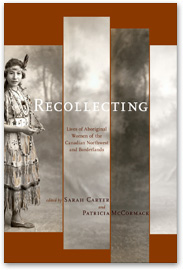
Recollecting: Lives of Aboriginal Women of the Canadian Northwest and Borderlands, edited by Sarah Carter and Patricia A. McCormack
Up until last week I thought my local library was only good for borrowing DVD’s, and stocking a non-fiction section that addresses the most cutting-edge issues of the early 1990’s. Imagine my delight when I saw among its new acquisitions a collection edited by Sarah Carter (she wrote The Importance of Being Monogamous: Marriage and Nation Building in Western Canada to 1915—a fascinating account of how fiercely guarded a particular idea of marriage and family [wa/i]s, and how central it was to Canadian nation-building).
The essays collected in this anthology are conscious that, as one such contributor specifically observes of Sara Riel, earlier writers of biography have only acknowledged women when they “[celebrate them] as an event in the life of a great man” (Erickson, 2011, 117). However, these authors take as their objective demonstrating how, “Aboriginal women, instead of fading into the background as traditional narratives of Western settlement suggest, remained at the forefront of their communities’ survival and persistence” (Burnett, 2011, p.158).
Given that traditional historical accounts are silent about the centrality of their female First Nations and Metis subjects, the contributors to this collection use multiple methods and rely on many sources of information. For instance, Susan Berry demonstrates how the information about artisan skill and style that one reads from an artefact might be read alongside HBC invoices and a traveller’s diary to extrapolate who the artist was. In uncovering these identities, Berry also fits these characters, and their stories (gleaned from HBC records, newspaper reports, etc.) into a travelogue that was originally silent about them. Moreover, she traces her subjects’ social location beyond their contact with the author of the diary to showcase the increasing marginalization of these highly skilled Metis women and their families with the progress of the Canadian state.
On the whole, this collection is full of well-written essays with authors whose use of sources is imaginative, innovative, interesting, and compelling. Additionally, several of the authors focus on the connection between first peoples and specifically their relatives who currently live in Scotland. Is this kind of diaspora much considered in the literature (I'm hardly a scholar of First Nations studies)?
The only suggestion I would have is if the reader is not familiar with Canadian history that s/he supplement this with a more traditional history resource. Indeed, it would provide needed context when the authors note an event like the Red River Rebellion but do not elaborate on it in detail.
Monday, July 11, 2011
The Tea Room Trade by Laud Humphreys

Well, for the past month I have fallen off the reading wagon, but I nevertheless can claim the distinction of remaining a Te[a]totaller this month, and in some pretty public places too.
A lot has already been said about the ethics of the research design that informed Laud Humphreys' Tea Room Trade: Impersonal Sex in Public Places (lookit me! citing Wikipedia :S), so I will not say too much about that here. I would just encourage people who think that his method sounds appalling that they should read the book; Humphreys really lays it out, and engages with his critics.
What was most striking to me was how different my impression of the book was relative to another summary I had heard of it. In an undergraduate introduction to research methods, one relatively coarse course instructor described Laud Humphreys as this researcher who spied on gay men when they had sex in washrooms. According to this man, Humphreys then followed them back to their houses and extorted people’s compliance with his research by interviewing them while their wives were at home. However, upon reading the book, what stood out to me was how my instructor re-evaluated its findings when he summarized it. Indeed, in this work, Humphreys distinguished several types of people who would be sexually active at the tea rooms, only one of whom might be called homosexual/gay/etc. However, my instructor apparently felt that he could dismiss this part of the analysis.
Like others many others I think treating sexual acts between men and homosexual identity as metonyms is a feature of the present day. This was underlined by what was not present in this book. Indeed, Humphreys did not take a stand about the logical difficulty of conflating acts with identity. Perhaps this is because this work was born in the 1960’s, before the Gay Liberation Movement suggested that being gay was a choice and presumably depended on the fulfillment of a set of (sexual) acts.
What was more pressing to Humphreys was critiquing the religious beliefs that he thought contributed to men’s experience of frigid relationships, and with which they were well-versed enough to hide behind whilst still engaging in illicit sex. Given his background as a radical Episcopal priest, this critique seems natural.
Sadly, the compelling argument with which Humphreys concludes—in which he refers to his findings that tearoom sex is not exploitative, that sex in private is much more likely to involve violence, and concludes that police harassment of people who engage in such sex does not contribute to public safety—was obscured by the ethical mess of his research design. In any case, the innovative method, and provocative arguments are definitely worth revisiting even forty years later.
Sunday, June 5, 2011
"Diseases of the Will" to return library books, care of adoring fan
Subscribe to:
Posts (Atom)